
Almost 63 per cent of the increased allocation of around Rs 1.01 trillion has been spent in the first five months of 2020-21.

ESI subscribers to get Covid unemployment allowance within 15 days of claim. Payment will be made into bank account of the insured and Aadhaar will be used for identification.

Opposition parties have alleged that the two agriculture Bills will undermine the safety net provided to the farmers by the MSP system and will lead to their exploitation by big companies.

Labour ministry guidelines say workers returning to cities must get housing, health insurance, facemasks. The Centre has also asked states to issue guidelines to employers to take care of the needs of migrant workers.

The remaining 0.35 per cent will be credited in December this year, if the EPFO is able to redeem its equity investments.

However, the growth, driven largely by a bumper rabi harvest and facilitated by relaxation in lockdown, may not have resulted in a big rise in income for a section of farmers.

The focus of the meeting will be on enabling businesses and households to avail of the revival framework on the basis of viability, necessary steps like finalising bank policies and identifying borrowers, and discussing issues that require addressing for smooth and speedy implementation.

Though agriculture ministry officials are confident of a bumper harvest due to record increase in kharif acreage, experts and farmers said the on-ground situation in some crops is not that encouraging as incessant rains since the last few weeks and pest attack could impact the final yield.

The ravines, which are sharp, steep mud hillocks, stretch over three states - Madhya Pradesh, Rajasthan, and Uttar Pradesh, once home to several dreaded dacoits have long been the subject of several projects and government schemes to make them agriculturally viable.
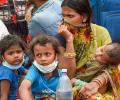
Only two in every five migrants said they received ration or cooked food from the administration either daily or at times.
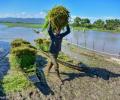
Reports said that in Telangana and Karnataka, excessive rains the past 10 days has threatened the standing green gram and maize crops and could negatively impact yields if the skies don't open up. But in the north-west and central parts of India, the resurgence of monsoon could not have come at a better time as oilseeds and pulses crops would otherwise had weathered if the rains didn't revive in August.

The restrictions imposed in March led to a sharp slump in demand from bulk consumers like hotels, restaurants, and roadside tea stalls, as they were forced to shut down. Sales of major milk products such as ice-cream, butter milk, and cheese, which usually spike during summer, also dropped.

The situation could become more acute as millions of migrants who had returned to their villages during the lockdown come back to the towns for higher wages and better livelihoods.

Swarms of immature pink locusts and adult yellow locusts are currrently active. Not only are fresh locusts swarms expected to arrive in the coming weeks, but even those already present in India have mated and are breeding new offspring.
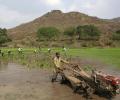
Much of the rural recovery story is based on the premise of agriculture doing well. Even if it clocks a growth of 2.5-3 per cent this year, it is still just around 15 per cent of the overall GDP. The non-farm sector, which constitutes a bigger portion of the overall rural economy, is now hampered by disruptions and lockdowns.

The plan could mature into either an umbrella programme for urban youths similar to the Garib Kalyan Rozgaar Abhiyaan or a modified urban-focused version of MGNREGS.

The met department said that rainfall in August is projected to be within the normal range at 97% of LPA. In August and September, India receives around 43 mm of rainfall.

However, demand was still much higher compared to the previous years, underlining the scheme's vital role in providing employment to the rural poor, a vast majority of whom are migrants.

The demand for milk and milk products slumped during the Covid-19 lockdown mainly from hotels, restaurants, sweetmeat shops which were shut to control the spread of the disease.

Between June 1 and July 28, about 32 per cent of the 685 districts in the country did not receive adequate rainfall.
 © 2026 Rediff.com - Advertise with us - Disclaimer - Privacy Policy - Sitemap - Feedback - About us - Terms of use - Grievances